

Measuring digital marketing success starts with setting clear goals like increasing website traffic, leads, or sales. Use Key Performance Indicators (KPIs) such as conversion rates, click-through rates (CTR), engagement on social media, and return on ad spend (ROAS) to evaluate performance.
Tools like Google Analytics and social media insights help you track real-time data and understand what’s working. Regularly compare results against your targets to identify strengths and weaknesses. Attribution models show which channels contribute most to conversions.
Continuously optimize campaigns based on data to improve ROI. With consistent measurement and adjustment, you can make smarter decisions and grow your digital presence in 2026.
How to Measure Digital Marketing Success

Digital marketing is powerful — but only if it delivers results.
Many businesses invest in SEO, paid ads, social media, and content marketing without clearly understanding whether those efforts are actually driving growth.
This leads to one critical question:
How to measure digital marketing success?
Measuring success goes beyond counting website visits or social media likes. It requires tracking meaningful performance indicators tied directly to business objectives.
In this guide, you’ll learn how to measure digital marketing success using the right metrics, tools, and strategies in 2026.
Why Measuring Digital Marketing Matters

Without measurement, marketing becomes guesswork.
Tracking performance helps businesses:
- Identify profitable campaigns
- Optimize underperforming strategies
- Allocate budget effectively
- Improve customer acquisition
- Increase return on investment (ROI)
Data-driven decisions outperform assumptions.
Measurement turns marketing into a scalable growth engine.
Step 1: Define Clear Marketing Goals

Before measuring success, define what success means for your business.
Common digital marketing goals include:
- Increasing website traffic
- Generating qualified leads
- Driving online sales
- Improving brand awareness
- Reducing customer acquisition cost
- Boosting customer retention
Every metric should connect to a specific goal.
Without clear objectives, metrics lack context.
Step 2: Identify Key Performance Indicators (KPIs)
KPIs are specific metrics used to track progress and determine how successfully objectives are being met.
Website Performance Metrics

If your goal is traffic growth, track:
- Total website visits
- Organic traffic
- Traffic sources
- Bounce rate
- Average session duration
Traffic indicates visibility — but traffic alone does not equal success.
Conversion Metrics
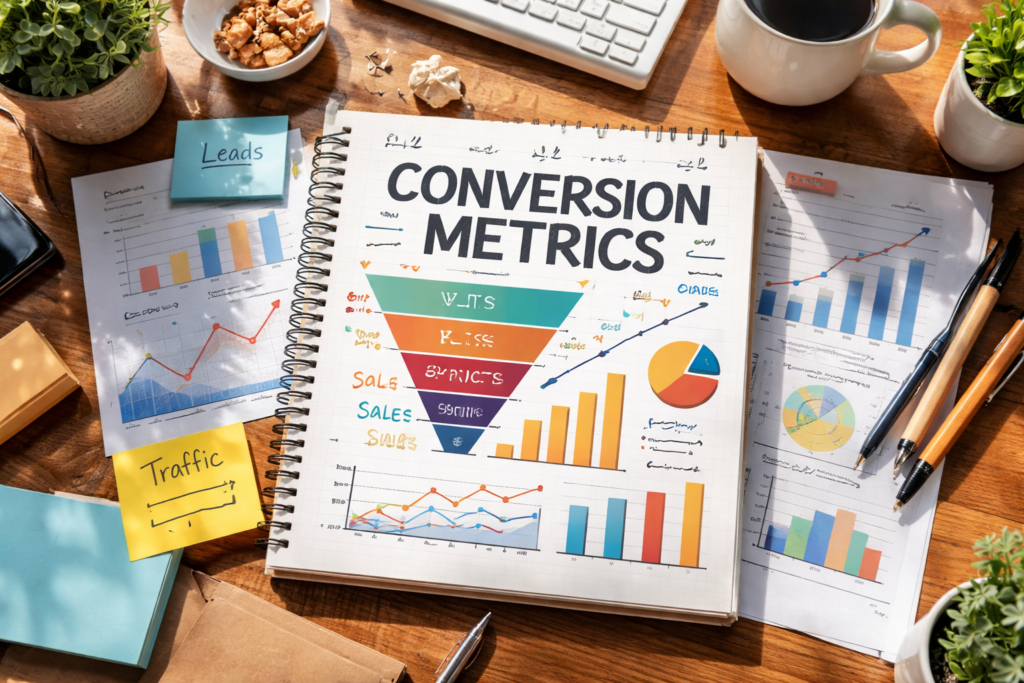
Conversion metrics are more meaningful than traffic.
Track:
- Conversion rate
- Cost per conversion
- Lead generation rate
- Form submissions
- Online purchases
Conversion rate reveals how well your website turns visitors into customers.
Revenue and ROI Metrics

Ultimately, marketing success depends on revenue.
Measure:
- Return on investment (ROI)
- Return on ad spend (ROAS)
- Customer lifetime value (CLV)
- Cost per acquisition (CPA)
These metrics determine profitability.
If marketing generates revenue above cost, it is successful.
SEO Performance Metrics

If your strategy includes SEO, monitor:
- Keyword rankings
- Organic traffic growth
- Click-through rate (CTR)
- Domain authority
- Backlink growth
SEO success is long-term and cumulative.
Paid Advertising Metrics

For paid campaigns, focus on:
- Cost per click (CPC)
- Click-through rate (CTR)
- Cost per acquisition (CPA)
- Conversion rate
- ROAS
Paid marketing should deliver measurable returns.
Social Media Performance Metrics

For social media marketing, measure:
- Engagement rate
- Reach and impressions
- Follower growth
- Click-through rate
- Social conversions
Engagement indicates audience interest.
Conversions indicate business impact.
Step 3: Track Customer Journey Metrics

Success isn’t always immediate.
Customers often interact with multiple touchpoints before converting.
Track:
- Multi-channel attribution
- Assisted conversions
- Funnel drop-off rates
- Time to conversion
Understanding the customer journey improves strategy optimization.
Step 4: Use Proper Analytics Tools

To measure digital marketing success accurately, use reliable tools such as:
- Website analytics platforms
- Advertising dashboards
- CRM systems
- Conversion tracking software
- Heatmap tools
Proper tracking ensures accurate data collection.
Data accuracy drives informed decisions.
Step 5: Calculate Marketing ROI

ROI is one of the most important indicators of success.
Formula:
ROI = (Revenue – Marketing Cost) ÷ Marketing Cost × 100
For example:
If you spend $5,000 on marketing and generate $15,000 in revenue:
ROI = ($15,000 – $5,000) ÷ $5,000 × 100
ROI = 200%
Positive ROI indicates profitable marketing.
Step 6: Analyze Lead Quality

Not all leads are equal.
Track:
- Lead-to-customer conversion rate
- Sales cycle length
- Customer retention rate
High-quality leads improve long-term growth.
Volume without quality reduces profitability
Step 7: Monitor Long-Term Growth Indicators

Digital marketing success includes sustainable growth.
Track:
- Brand search volume
- Repeat purchase rate
- Customer loyalty metrics
- Email subscriber growth
Long-term success extends beyond immediate sales.
Common Mistakes When Measuring Marketing Success

Avoid these errors:
Focusing Only on Vanity Metrics
Likes and impressions don’t guarantee revenue.
Ignoring Attribution Models
Last-click attribution may undervalue certain channels.
Not Aligning Metrics with Goals
Traffic means little if your goal is revenue.
Measuring Too Soon
Some marketing methods, such as SEO, need time before you start seeing noticeable results.
Effective measurement requires context and patience
How Often Should You Measure Performance?

Regular monitoring is essential.
Recommended review schedule:
- Weekly for paid campaigns
- Monthly for SEO and content marketing
- Quarterly for strategic analysis
Frequent reviews allow early optimization.
How to Improve Digital Marketing Performance

Measurement is only useful if it leads to improvement.
To optimize performance:
- A/B test landing pages
- Refine audience targeting
- Adjust ad copy
- Improve user experience
- Update content strategy
Continuous optimization drives sustainable growth.
Short-Term vs Long-Term Success Metrics

Short-term success includes:
- Immediate conversions
- Paid ad performance
- Campaign ROI
Long-term success includes:
- Organic growth
- Brand authority
- Customer loyalty
- Lower acquisition costs
Balancing both perspectives ensures stability.
Frequently Asked Questions
What is the most important metric in digital marketing?
ROI is often the most important metric because it shows how profitable your marketing efforts are, but the key metric depends on your specific business goals.
How do small businesses measure success?
By tracking conversions, cost per acquisition, and revenue growth.
Can digital marketing success be measured accurately?
Yes, when proper tracking tools and KPIs are used.
How long does it take to see results?
Paid campaigns show quick results. SEO and content strategies require months.
Final Thoughts
Understanding how to measure digital marketing success is essential for data-driven growth.
Success is not defined by traffic alone.
It requires:
- Clear goals
- Relevant KPIs
- Conversion tracking
- ROI calculation
- Continuous optimization
In 2026, businesses that measure performance accurately outperform competitors who rely on assumptions.
Digital marketing is not just about visibility — it is about measurable impact.
Track smarter. Optimize consistently. Grow sustainably.