
Digital Marketing Strategy 2026 focuses on building a clear and data-driven roadmap for business growth. It combines SEO, social media marketing, paid advertising, and content marketing to create consistent brand visibility.
Businesses must leverage AI tools, automation, and personalized campaigns to stay competitive. Customer journey mapping and audience targeting play a key role in improving conversions. Performance tracking and analytics help optimize campaigns for better ROI.
A strong digital marketing strategy in 2026 ensures sustainable growth and long-term success.
What Is Digital Marketing Strategy?
In today’s crowded online environment, just having a website or running ads isn’t enough. Businesses need a clear plan that connects their marketing efforts to measurable results.
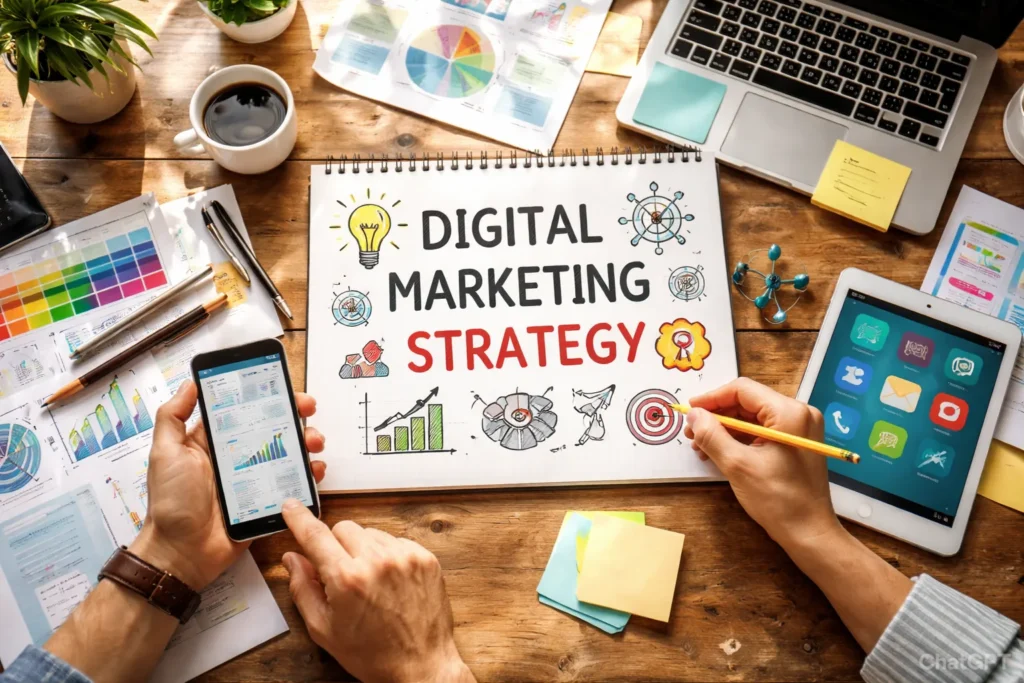
A digital marketing strategy is more than posting content or launching campaigns. It is a structured roadmap showing how a business will use online channels, messaging, and data to achieve specific goals.
It brings together audience targeting, content creation, paid campaigns, SEO, and analytics into a unified system for growth.Without a strategy, marketing is scattered.
With a strategy, marketing becomes focused, measurable, and scalable.
Key Definition

A digital marketing strategy is a detailed plan that includes:
- Target audience
- Marketing objectives
- Channels and platforms
- Content approach
- Budget planning
- Performance measurement
It ensures every action supports overall business goals, creating alignment and consistency instead of disconnected campaigns.
Why Digital Marketing Strategy Matters
Many businesses invest in:
- Social media marketing
- Paid advertising
- Email campaigns
- SEO
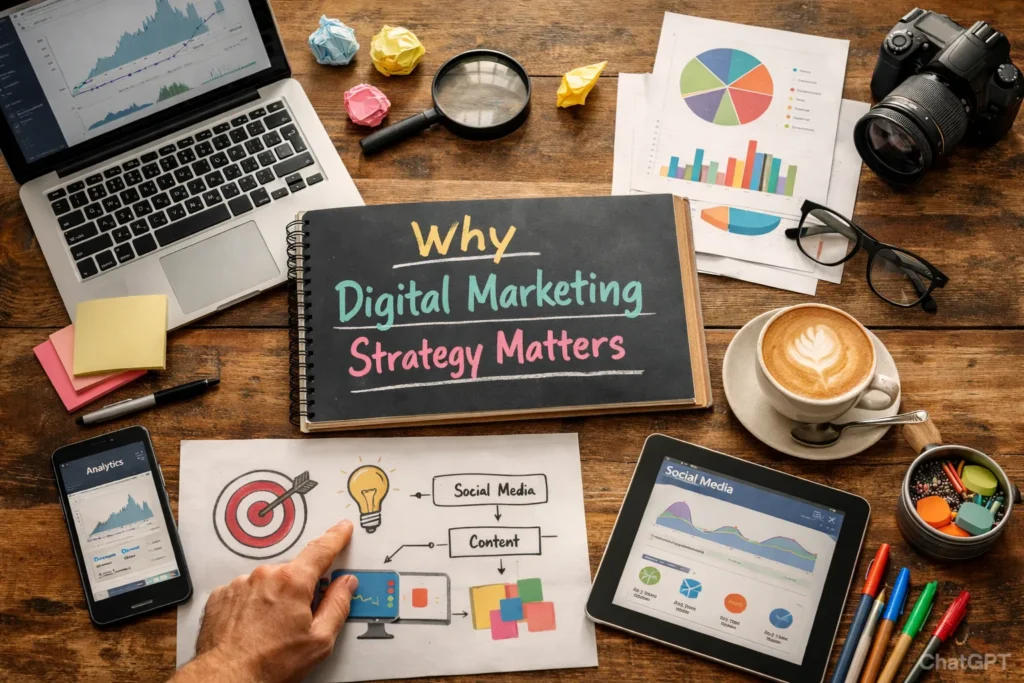
But without a clear strategy, these efforts can be ineffective. A strong digital marketing strategy:
- Provides clarity on goals
- Optimizes budget usage
- Enhances audience targeting
- Strengthens brand positioning
- Maximizes ROI
In short, strategy transforms marketing from trial-and-error into predictable growth.
Core Components of a Digital Marketing Strategy
1. Defined Business Goals

Every strategy starts with clear objectives such as:
- Lead generation
- Website traffic growth
- Brand awareness
- Increased sales
- Customer retention
Goals must be measurable to track success.
2. Audience Analysis & Buyer Personas

Understanding your audience is essential. This includes:
- Demographics
- Pain points
- Purchase behavior
- Online habits
- Preferred platforms
Detailed buyer personas help deliver messages that resonate and improve conversion rates.
3. Channel Strategy

Digital marketing includes channels like:
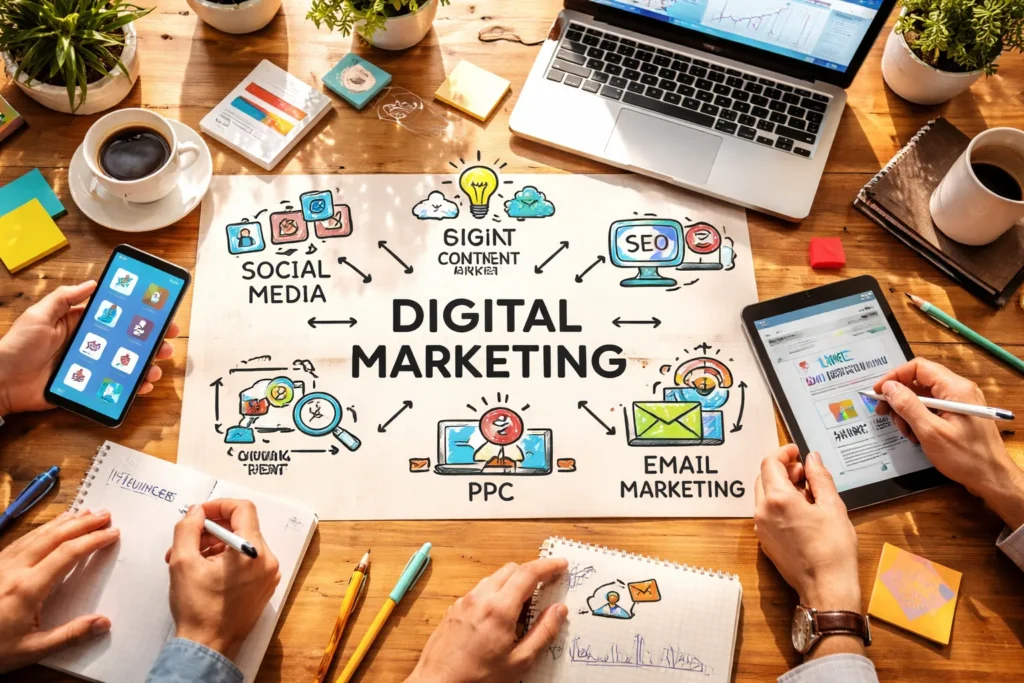
- SEO
- PPC advertising
- Social media marketing
- Email campaigns
- Content marketing
- Influencer collaborations
Not every channel fits every business. Strategic selection ensures efficiency.
4. Content Strategy

Content is the backbone of digital marketing. A strategy defines:
- Topics and themes
- Formats (blogs, videos, guides)
- Publishing frequency
- SEO integration
- Brand voice
Consistent content builds authority and trust over time.
5. Paid Advertising Approach

Paid campaigns accelerate growth when aligned with strategy. Key steps include:
- Budget allocation
- Audience targeting
- Campaign structure
- Conversion tracking
- Optimization
6. Data & Analytics

Data guides decision-making. Metrics tracked include:
- Traffic sources
- Conversion rates
- Cost per acquisition (CPA)
- Return on ad spend (ROAS)
- Engagement metrics
Continuous monitoring ensures ongoing improvement.
Strategy vs. Tactics

Many confuse strategy with tactics.
- Tactics are individual actions (e.g., posting on Instagram or running a Google Ads campaign).
- Strategy explains why and how these actions connect to broader business goals.
Example:
- Tactic: Launch a PPC campaign
- Strategy: Generate 100 qualified leads per month at a target cost per acquisition
Strategy guides and aligns tactics.
Types of Digital Marketing Strategies
- Growth-Focused: Emphasizes fast customer acquisition via paid ads.
- Authority-Based: Focuses on SEO, content marketing, and brand credibility.
- Conversion-Focused: Optimizes funnels, landing pages, and remarketing campaigns.
- Hybrid: Combines organic and paid methods for balanced growth.
Most successful businesses use hybrid approaches.
How to Build a Digital Marketing Strategy
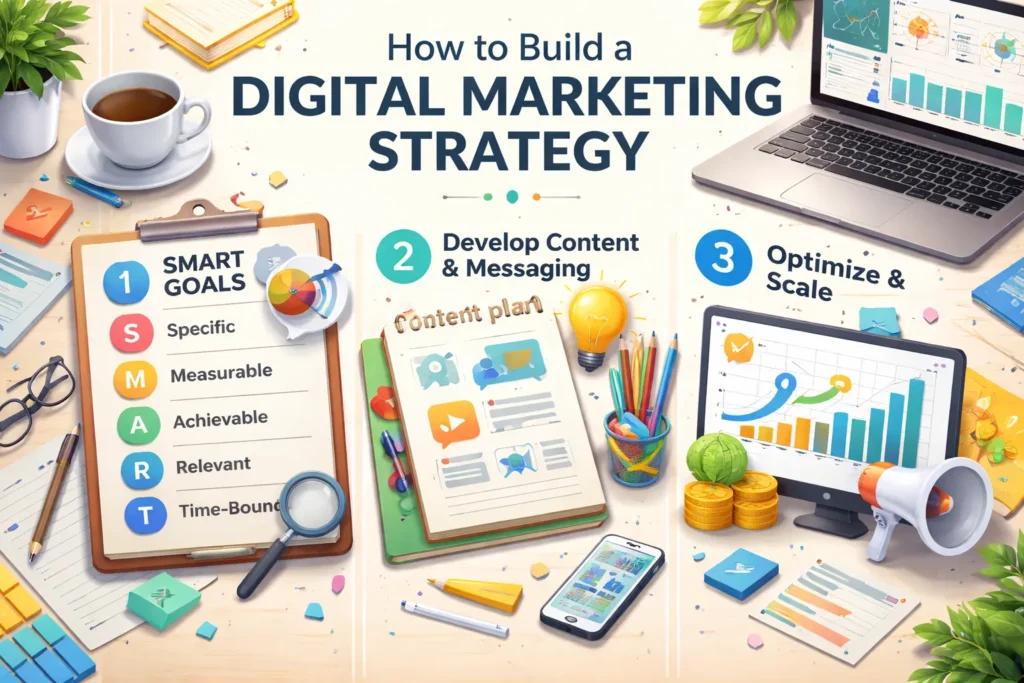
Step 1: Set SMART Goals
Goals should be Specific, Measurable, Achievable, Relevant, and Time-bound.
Step 2: Conduct Market Research
Analyze competitors, trends, customer demand, and search behavior to guide positioning.
Step 3: Choose Channels
Pick platforms where your audience is most active (e.g., LinkedIn for B2B, social ads for e-commerce).
Step 4: Develop Content & Messaging
Define your brand voice, value proposition, and content calendar for consistent messaging.
Step 5: Implement Tracking
Use analytics tools to monitor performance and make data-driven adjustments.
Step 6: Optimize & Scale
Regularly review campaigns to refine targeting, messaging, budgets, and content. Optimization is ongoing.
Benefits of a Strong Strategy

A structured digital marketing strategy delivers:
- Higher ROI
- Better engagement
- Stronger brand recognition
- Lower acquisition costs
- Sustainable growth
Strategic clarity reduces wasted effort and improves results.
Common Mistakes to Avoid

- Undefined goals
- Over-reliance on a single channel
- Ignoring data
- Inconsistent branding
- Short-term thinking
Avoiding these pitfalls strengthens overall marketing execution.
Digital Marketing Strategy in the Age of AI

AI is reshaping marketing strategies:
- Ad optimization
- Automated bidding
- Predictive analytics
- Personalized experiences
- Data segmentation
AI enhances precision, but human insight remains critical for strategic planning.
Frequently Asked Questions
Q: What is a digital marketing strategy in simple terms?
It’s a clear plan showing how a business uses online channels to achieve marketing goals.
Q: Why is it important?
It aligns all marketing efforts with measurable objectives and improves ROI.
Q: How often should strategies be updated?
Review quarterly and adjust based on performance metrics.
Q: Can small businesses benefit?
Yes, even small budgets see better results with a structured strategy.
Final Thoughts
A digital marketing strategy provides direction, clarity, and measurable outcomes. Businesses that combine data-driven insights with strategic planning will outperform competitors in 2026.Marketing without strategy is inconsistent.
Marketing with strategy is measurable, scalable, and growth-driven.