
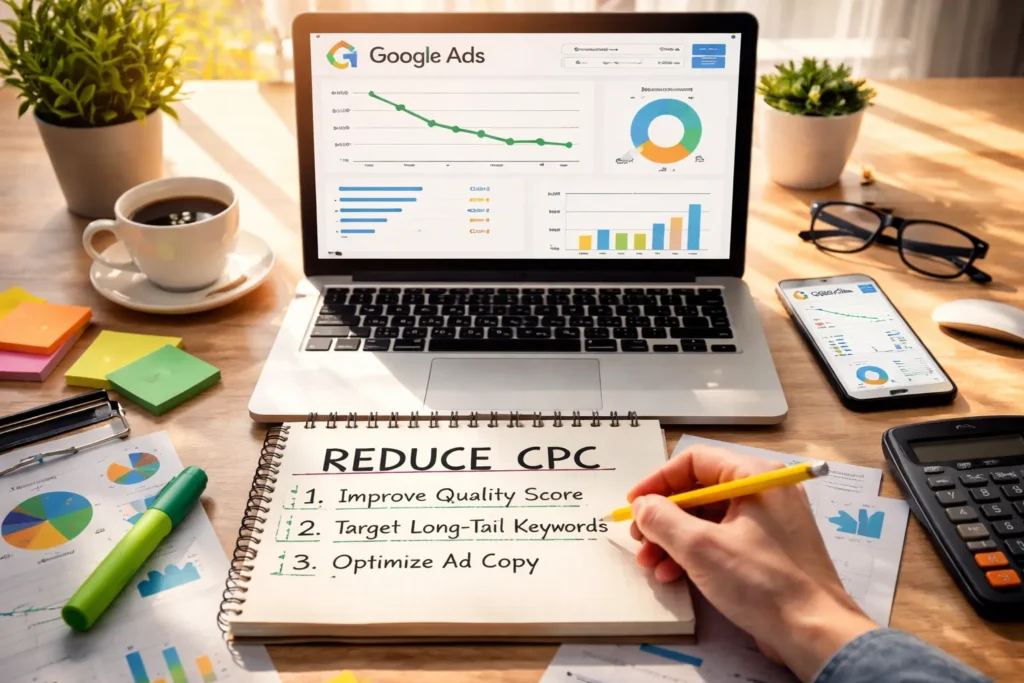
Running Google Ads can be one of the fastest ways to generate leads, sales, and consistent traffic. But when your cost per click keeps climbing, even strong campaigns can become unprofitable.
If you’re searching for how to reduce cost per click in Google Ads, you’re focusing on one of the most important areas of PPC optimization.
The truth is: lower CPC doesn’t come from bidding lower. It comes from improving the factors Google uses to decide whether your ad deserves top placement at a lower price.
In this guide, you’ll learn practical and proven ways to reduce CPC in Google Ads while maintaining — and often improving — results in 2026.
What Is Cost Per Click (CPC) in Google Ads?
Cost Per Click (CPC) is the amount you pay when someone clicks your Google ad.
Google Ads uses an auction system, but the winner isn’t always the highest bidder. Your actual CPC depends on a combination of:
Your maximum bid
Competitor bids in the same auction
Your Quality Score
Your ad relevance
Landing page experience
Expected click-through rate (CTR)
That’s why advertisers with better ads and better landing pages often pay less — even in competitive industries.
Why Your CPC Keeps Increasing
Before fixing high CPC, you need to know what’s causing it.
The most common reasons CPC rises include:
More advertisers entering your market
Low Quality Score
Ads that don’t match search intent
Broad keyword targeting
Weak landing page experience
Poor CTR
Missing negative keywords
Sending traffic to irrelevant pages
The good news: most of these problems are fully fixable.
1. Improve Quality Score (The Fastest Way to Lower CPC)

Quality Score is one of the strongest levers for CPC reduction.
Google wants to show ads that users actually like and engage with. When your Quality Score improves, Google rewards you with:
Lower CPC
Better ad positions
Higher impression share
More clicks for the same budget
How to Improve Quality Score in 2026
To increase your score, focus on:
Using keywords that match your ad message
Writing headlines that reflect the search query
Creating tightly themed ad groups
Improving landing page relevance
Increasing CTR with stronger copy and offers
Optimizing mobile speed and usability
In simple terms: when your ad feels like the perfect answer, Google charges you less.
2. Target Long-Tail Keywords Instead of Expensive Broad Terms
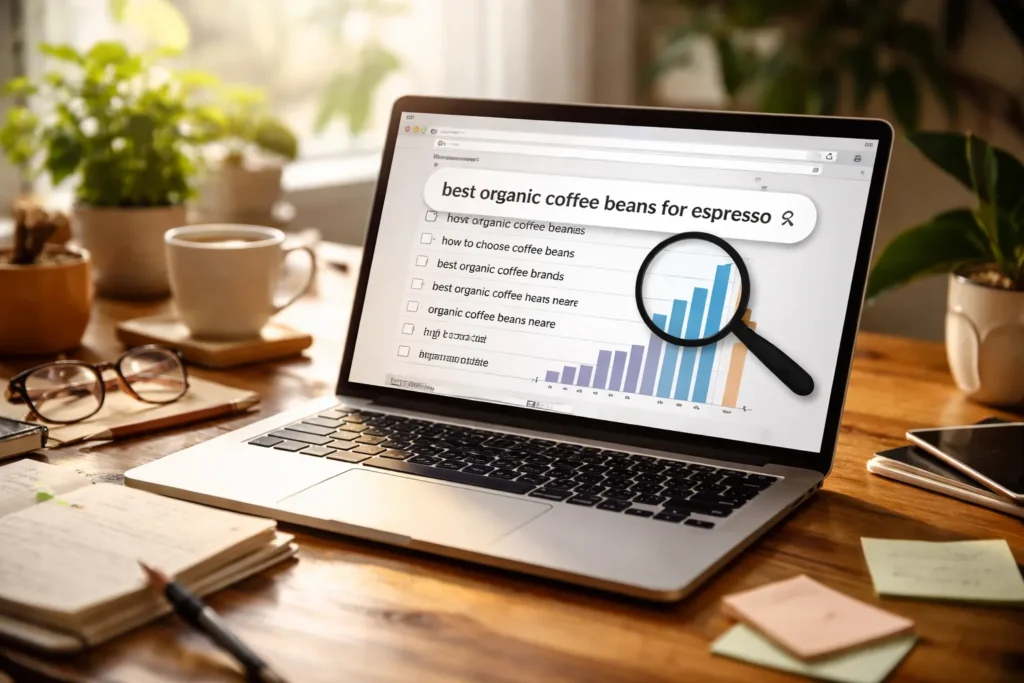
Broad keywords are usually expensive because they attract large competition and mixed intent.
For example, a keyword like:
“marketing agency”
is too broad and competitive.
A long-tail keyword like:
“digital marketing agency for ecommerce startups”
is more specific, usually cheaper, and often converts better.
Why long-tail keywords reduce CPC
They typically:
Face less bidding competition
Attract higher-intent visitors
Improve Quality Score due to better relevance
Produce better conversion rates
This makes long-tail targeting one of the most profitable strategies for CPC reduction.
3. Add Negative Keywords (Stop Paying for Wrong Clicks)
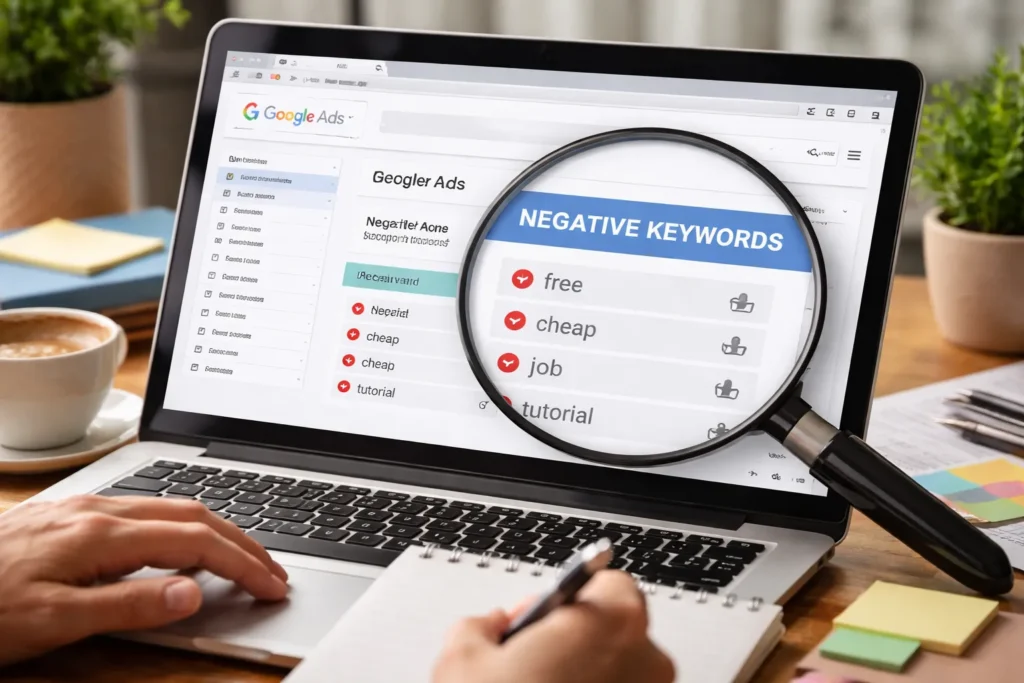
Negative keywords prevent your ads from appearing for irrelevant searches.
This is one of the easiest ways to reduce wasted spend, especially in Search campaigns.
For example, if you offer premium services, you may want to block terms like:
“free”
“cheap”
“internship”
“job”
“training”
Best practice
Check your Search Terms Report weekly and continuously add negatives. Even small improvements here can lower CPC and raise conversion quality.
4. Write Ad Copy That Improves CTR

Google strongly cares about CTR because it measures how relevant your ad is to the user.
If your CTR is low, Google assumes your ad is not the best option — and your CPC rises.
Ways to increase CTR
Improve engagement by:
Including the main keyword naturally in the headline
Using a clear benefit (not generic wording)
Adding urgency when appropriate
Using a strong call-to-action
Highlighting what makes you different
A higher CTR usually increases Quality Score, and that often lowers CPC over time.
5. Tighten Targeting So You Compete Less

Many advertisers waste budget by targeting too broadly.
The more people you target, the more auctions you enter — and the more expensive it becomes.
Better targeting ideas
Reduce CPC by:
Narrowing location targeting (city-level, not country-level)
Adjusting bids by device
Using demographic filters
Excluding low-performing age groups (when relevant)
Refining audience segments
Smarter targeting reduces unnecessary competition and improves overall efficiency.
6. Improve Landing Page Experience (CPC Drops When UX Improves)
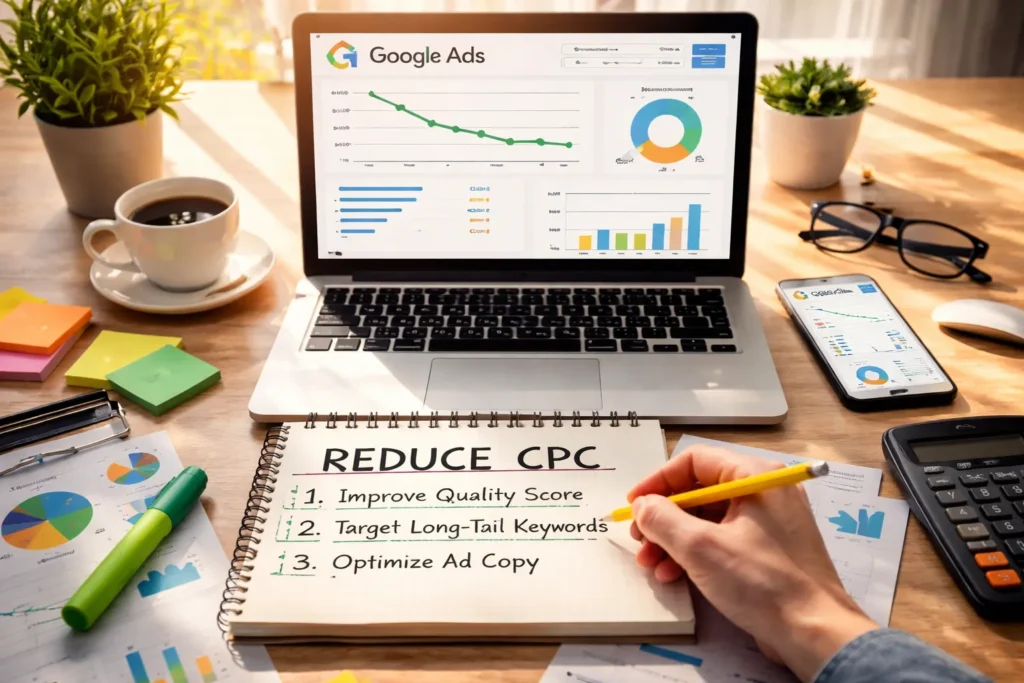
Landing page experience is a key Quality Score component.
If users click your ad and immediately leave, Google assumes your page is not helpful.
A high-quality landing page should:
Load fast (ideally under 3 seconds)
Match the ad headline and promise
Be mobile-friendly
Have a clear CTA
Use simple design and readable content
Provide trust signals (reviews, badges, guarantees)
Better landing pages often reduce CPC and increase conversions at the same time.
7. Choose the Right Bidding Strategy

Bidding strategy affects how Google competes in auctions on your behalf.
Manual bidding
Manual CPC can work well when:
You have strong tracking
You monitor campaigns regularly
You want full control
Smart bidding
Automated strategies can reduce wasted spend when optimized correctly, such as:
Maximize Conversions
Target CPA
Enhanced CPC
Target ROAS (for ecommerce)
The key is to test and monitor. Automated bidding works best when your conversion tracking is accurate and consistent.
8. Use Ad Extensions to Improve Ad Rank
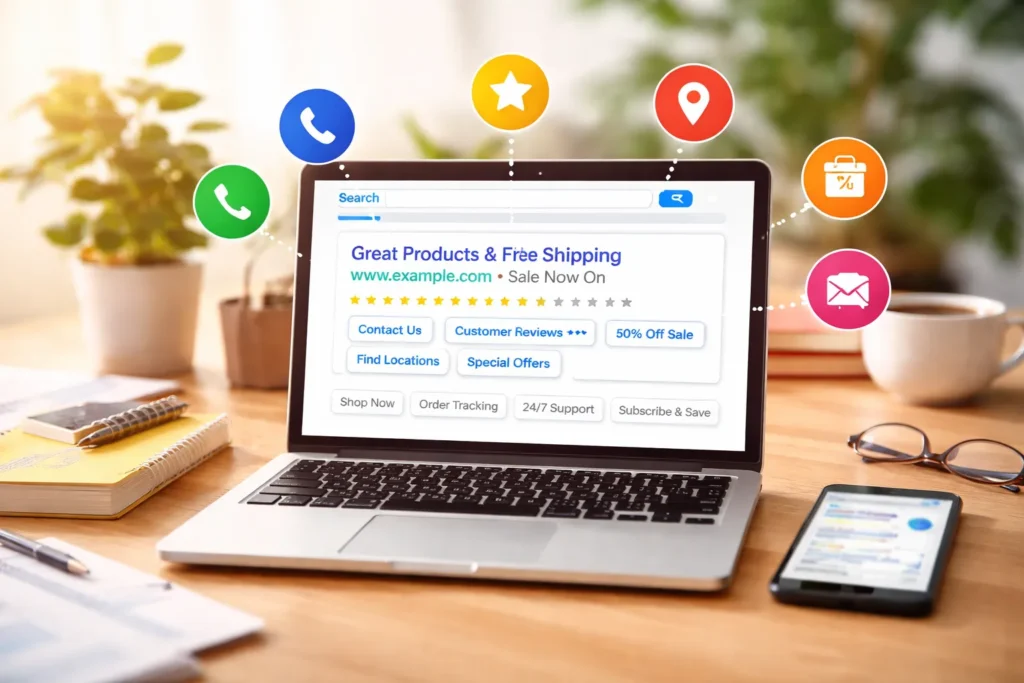
Ad extensions (now often called “assets”) make your ads larger and more clickable.
More engagement improves Ad Rank, which can reduce CPC indirectly.
High-performing extensions include:
Sitelinks
Callouts
Structured snippets
Call extensions
Price extensions (if relevant)
Promotion extensions
Extensions don’t just improve visibility — they improve performance signals that Google rewards.
9. Optimize Ad Scheduling to Avoid Low-Quality Clicks
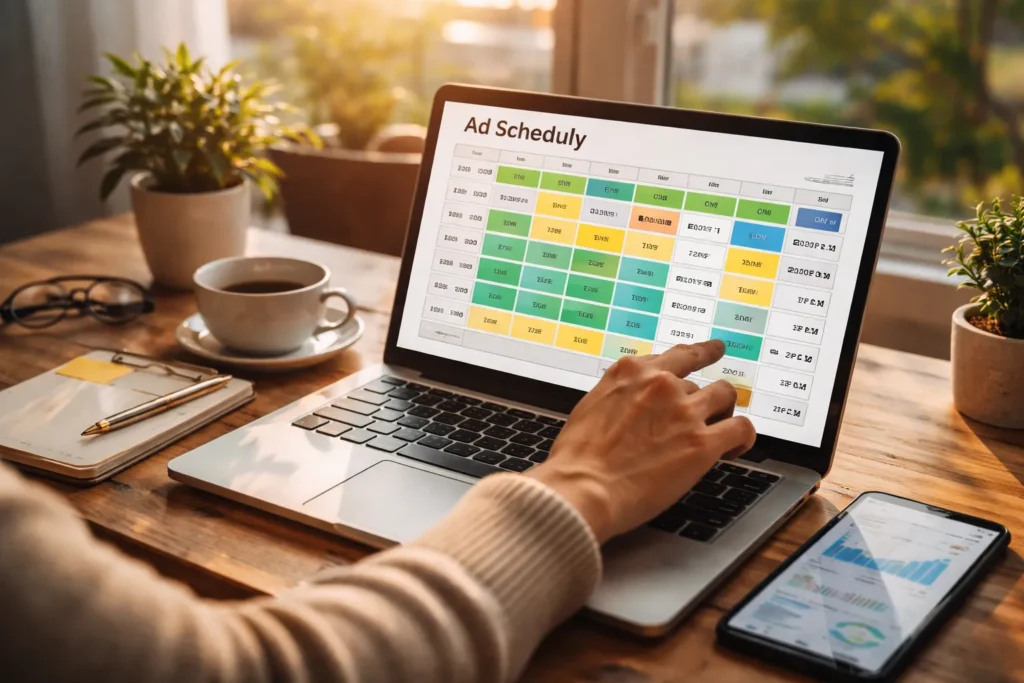
Not every hour of the day performs equally.
Some time periods generate clicks but no conversions, which raises CPC and wastes budget.
What to do
Use performance reports to identify:
High-converting hours
Days with low conversion rate
Time periods with expensive CPC but weak ROI
10. Reduce Competition Using Niche Campaigns

If you only chase the most competitive keywords, your CPC will almost always stay expensive.
A more effective strategy is to reduce competition by focusing on smaller, high-intent groups where fewer advertisers are bidding.
Examples of niche targeting
- Local campaigns (city + service)
- Industry-focused campaigns (service + niche)
- Problem-based keywords (solution-driven searches)
- Competitor brand targeting (only after careful testing)
In many cases, less competition leads to lower CPC and stronger buyer intent, which often improves overall performance.
11. Improve Conversion Rate (So CPC Matters Less)
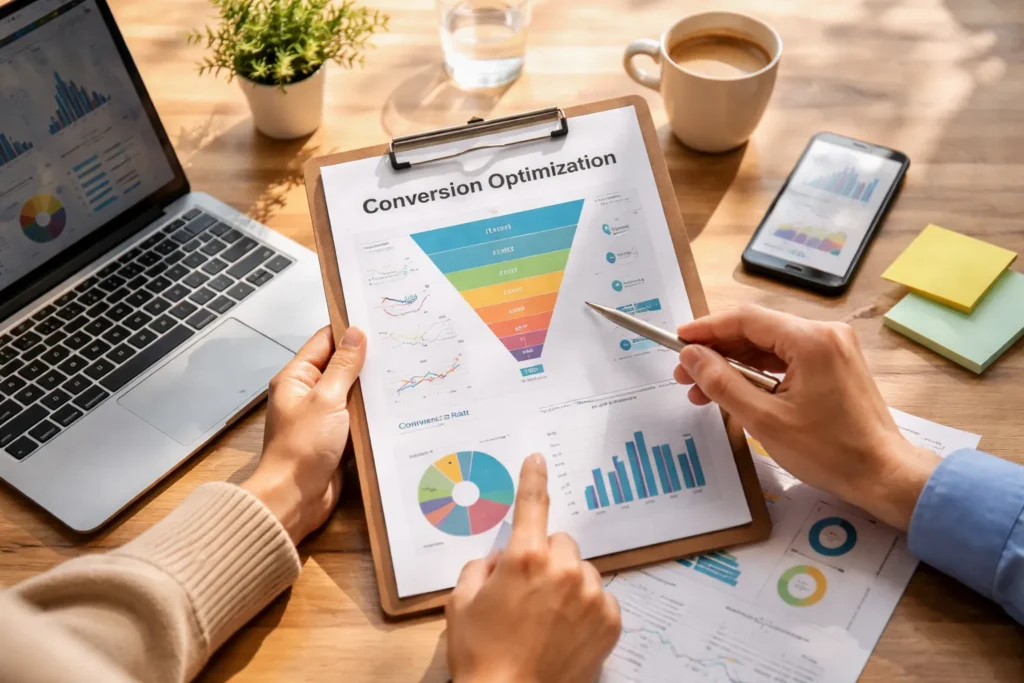
Lowering CPC helps — but improving your conversion rate often creates a much bigger increase in profit.
When your conversion rate improves, you can afford a slightly higher CPC while still lowering your cost per acquisition.
CRO upgrades that work well in 2026
- Shorter, simpler forms
- Clearer headlines and better page layout
- Strong trust signals
- Visible pricing or packages
- Testimonials and case studies
- Mobile-first improvements
- Faster load speed
If conversions rise, your ROI improves — even if CPC doesn’t change much.
12. Use Remarketing to Reduce Your Effective Costs

Remarketing often delivers:
- Lower CPC
- Higher conversion rates
- Better return on ad spend
Because you’re reaching people who already recognize your brand.
Remarketing works best for:
- Visitors who left without taking action
- Users who started a lead form but didn’t finish
- People who viewed product pages
- Past customers (upsell or repeat purchase campaigns)
Warm traffic is almost always more affordable and more profitable than cold traffic.
How Much Can CPC Be Reduced?
The amount you can reduce CPC depends on your industry, competition, and how well your account is currently optimized.
That said, with consistent improvements, many advertisers see CPC reductions such as:
- 10% to 30% in competitive industries
- 30% or more in local or niche markets
The biggest drops usually come from improving Quality Score, tightening keyword strategy, and upgrading landing page experience.
Common Mistakes That Keep CPC High
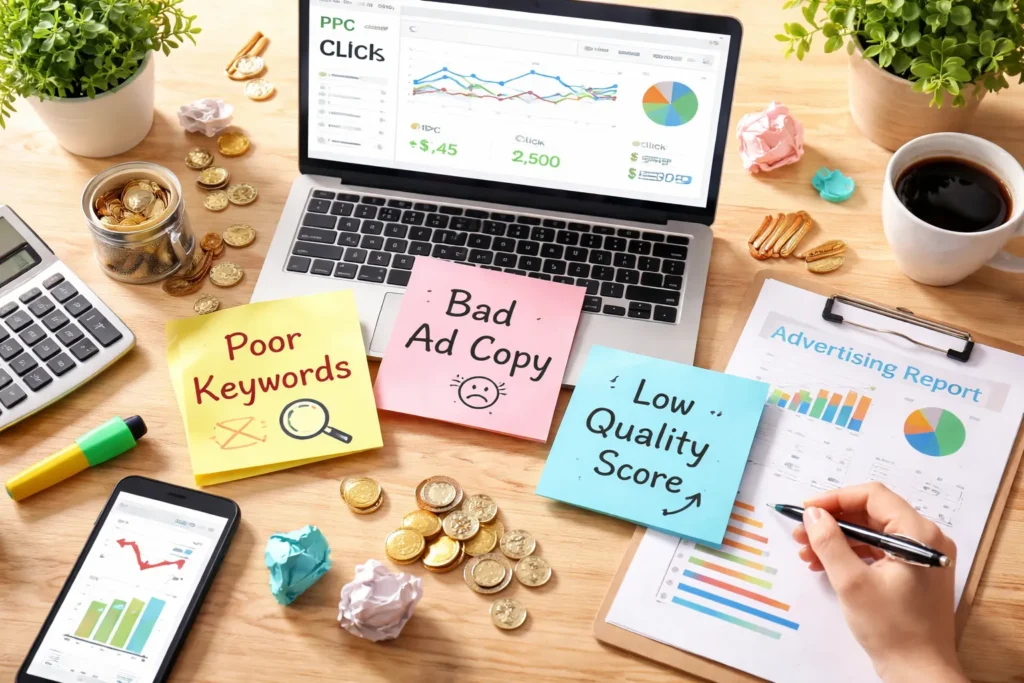
Many advertisers unintentionally keep CPC high because of avoidable setup issues.
Here are the most common ones:
- Using broad match without proper controls
- Not monitoring Quality Score signals
- Sending traffic to generic or irrelevant landing pages
- Running outdated ad copy for too long
- Skipping negative keyword updates
- Poor conversion tracking setup
- Targeting locations or audiences too broadly
Fixing even a few of these can quickly improve efficiency and reduce wasted spend.
Frequently Asked Questions
What is a good CPC in Google Ads?
A “good” CPC depends on your industry, margins, and conversion rate. The real goal isn’t cheap clicks — it’s clicks that turn into profitable customers.
Does lowering bids reduce CPC?
Not always. Lower bids can reduce your visibility and ranking, but CPC is strongly affected by Quality Score and Ad Rank — not just bid amount.
Can small businesses lower CPC in 2026?
Yes. Small businesses can compete by focusing on relevance, using long-tail keywords, improving landing pages, and targeting smaller high-intent segments.
Is CPC the most important metric?
No. CPC is useful, but profitability matters more. Most businesses should prioritize CPA and ROI over CPC alone.
Final Thoughts
Lowering CPC in Google Ads is possible in nearly every industry — but it requires smart strategy, not random changes.
The most reliable ways to reduce CPC in 2026 include:
- Improving Quality Score
- Using long-tail and high-intent keywords
- Adding negative keywords consistently
- Increasing CTR with stronger ad copy
- Improving landing page relevance and speed
- Refining targeting, locations, and ad schedule
- Using ad extensions and remarketing
- Optimizing conversion rate through CRO
When CPC decreases and conversions improve, Google Ads becomes a scalable growth channel — not just an ongoing cost.