
The future of SEO is evolving rapidly as AI becomes a core part of how search engines understand and deliver information. Traditional keyword-based strategies are giving way to approaches that prioritize user intent, content quality, and trustworthiness. AI systems evaluate pages not just for keywords but for clarity, relevance, and expertise, making authoritative content more important than ever.
Visual and structured content, such as tables, FAQs, and summaries, are increasingly favored by AI-powered search results. Brands and creators who focus on building topical authority and reliable information will see better visibility in AI-driven search environments. Ultimately, SEO is becoming less about manipulation and more about genuinely helping users find accurate answers.
This shift makes continuous learning and adapting essential for success in 2026 and beyond.
The Future of SEO in the Age of AI

Search is going through its biggest evolution since Google became the main gateway to the internet. Artificial intelligence is transforming how search engines interpret queries, generate responses, and decide which websites deserve exposure. Traditional ranking models are shifting into AI-powered systems that prioritize answers, not just links — and businesses need to move fast to keep up.
If you’re studying the future of SEO in the age of AI, one key reality stands out:
SEO is no longer only about ranking pages — it’s about building trust that AI systems confidently use.
From 2026 onward, SEO will be defined by intent, context, semantic coverage, and structured authority. This guide explains what’s changing and how brands can stay competitive.
How AI Is Changing Search Behavior

Today’s AI-driven search experiences can:
- Produce direct summaries
- Respond conversationally
- Process longer and more complex questions
- Detect intent more precisely
- Understand context across related topics
People are no longer searching with short keyword fragments. Instead, they type or speak full questions in natural language.
Example:
Old Search: “SEO strategy 2020”
Modern Search: “What is the best SEO strategy in the age of AI?”
This shift affects how content should be written and organized. Search is moving away from keyword matching and toward meaning and intent.
From Search Engine to Answer Engine

One of the biggest developments shaping SEO’s future is the growth of answer engines.
Rather than only showing ranked pages, AI systems now:
- Offer instant AI-generated responses
- Pull out key points for users
- Blend information from several sources
- Reduce the need for clicks
Because of this, SEO success is no longer only about reaching #1. Visibility now also means being mentioned or used as a source inside AI summaries.
The future will reward brands that are structured, credible, and easy for AI systems to extract.
Core Trends Shaping the Future of SEO
1. Intent-Led Optimization Will Replace Keyword Obsession
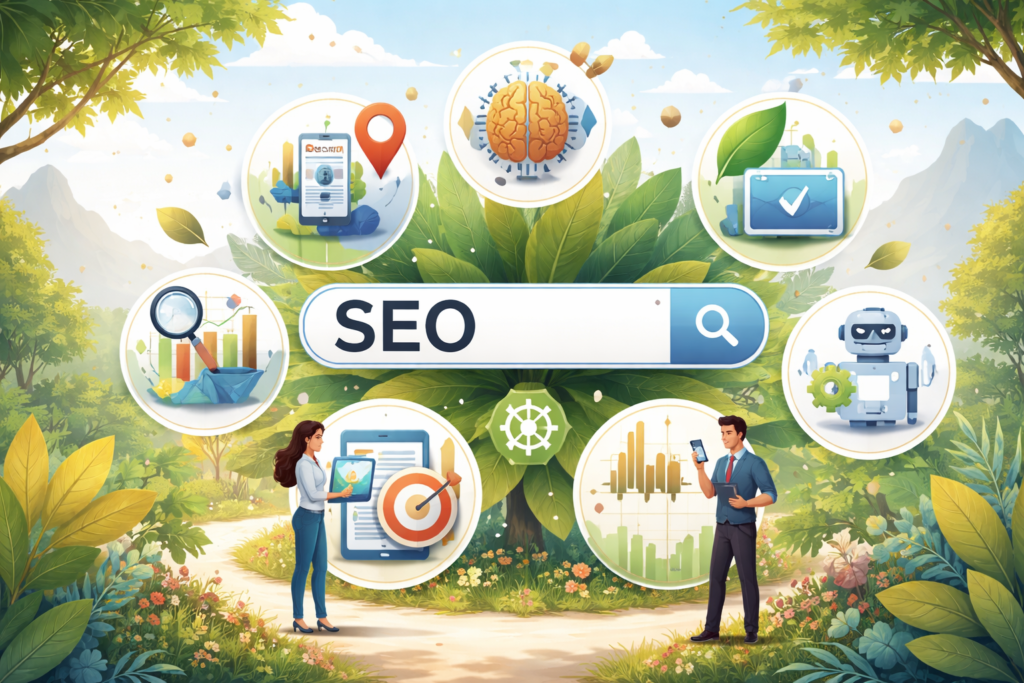
Keywords still matter, but intent is now the stronger signal.
AI can understand:
- What the user is trying to achieve
- The meaning behind the query
- Context and related signals
- Connected topics and entities
SEO must shift from “ranking for keywords” to “solving the user’s real problem.”
Future SEO will prioritize:
- Content built around context
- Question-based formatting
- Natural language writing
- Clear, solution-focused explanations
2. Topical Authority Will Lead Rankings

In AI-driven search, one good article is rarely enough.
Search engines evaluate authority across the whole website by looking at:
- Depth of coverage
- Internal linking quality
- Topic completeness
- Semantic consistency
To compete in the future, you must:
- Build pillar content
- Develop topic clusters
- Cover subtopics thoroughly
- Link pages strategically
Authority grows when your site becomes a full knowledge hub.
3. E-E-A-T Will Become Even More Valuable

Experience, Expertise, Authoritativeness, and Trustworthiness will play an even bigger role in AI-powered search.
Because AI-generated content is everywhere, search engines are becoming stricter about quality. Websites must prove:
- Real experience in the topic
- Recognized expertise
- Reliable sources and references
- Transparent authorship
- Strong consistency across the niche
Trust will separate real brands from generic AI content websites.
4. Generative Engine Optimization (GEO) Will Grow

Traditional SEO aims for rankings.
Generative Engine Optimization aims for inclusion inside AI-generated answers.
Future-focused SEO must include:
- Structured layouts
- Simple, clear definitions
- Short and accurate explanations
- Schema markup
- Strong semantic relevance
In 2026, visibility will depend on how easily AI can understand and summarize your content.
5. Conversational and Voice Search Will Expand

Conversational search and AI assistants are increasing rapidly.
Users now ask questions like:
- “How does AI change SEO rankings?”
- “What is the future of marketing with AI?”
Future SEO content must:
- Sound natural and human
- Answer questions early and clearly
- Include FAQ-style sections
- Avoid keyword-stuffed language
Content that feels natural will outperform content written only for algorithms.
6. Technical SEO Will Stay Essential

Even in the AI era, technical SEO remains a core requirement.
Websites still need:
- Strong page speed
- Mobile-first design
- HTTPS security
- Clear site structure
- Proper crawl access
AI systems still depend on technical signals to process, interpret, and extract website content. Technical foundations remain critical.
What Will SEO Look Like in 2026 and Beyond?
The future of SEO in the AI age can be explained through five major shifts:
From Rankings to Visibility
Being referenced in AI answers will matter as much as ranking at the top.
From Keywords to Context
Semantic relationships will become more important than exact keyword matches.
From Volume to Depth
Detailed topic coverage will outperform mass publishing.
From Traffic to Authority
Trust and credibility will drive long-term performance.
From Static Pages to Knowledge Hubs
Websites will become connected ecosystems of information.
SEO will become more strategic, more structured, and less mechanical.
How Businesses Should Prepare for the Future

To stay competitive, businesses should focus on:
Build Structured Content Ecosystems
Create connected clusters of content instead of isolated blog posts.
Combine AI Tools With Human Expertise
AI can speed up production, but human knowledge creates trust and authority.
Prioritize Semantic SEO
Use related concepts, entities, and contextual language to strengthen topical depth.
Optimize for Extractability
Use:
- Clear headings
- Bullet points
- Direct definitions
- Structured formatting
This helps AI systems scan and summarize your content more easily.
Improve User Experience
Engagement signals like time on page and interaction still matter. Clear content improves retention, and retention supports authority.
Challenges in the Age of AI

The future of SEO also brings new challenges:
- Competition increasing across all industries
- Reduced clicks for informational searches
- Higher content standards
- Difficulty tracking visibility inside AI answers
But these challenges benefit businesses that build long-term credibility instead of chasing shortcuts.
SEO Is Not Dying — It Is Evolving

Many people believe AI will kill SEO. That’s not true.
SEO is evolving, not disappearing.
Search engines still require:
- Well-structured websites
- Relevant and accurate content
- Trusted domains
- Clear information
AI is changing how search results are delivered, but optimization is still necessary. The difference is that modern SEO demands more strategy, more authority, and more trust.
Frequently Asked Questions
Is SEO still useful now that AI is everywhere?
Absolutely. SEO is still a key part of growth, but it now works best when content is clear, accurate, and built around real user needs—not just keywords.
Will AI take over and replace search engines?
No. Search engines aren’t disappearing. AI is simply changing how results are shown by giving faster summaries and smarter answers.
What is the biggest change coming in SEO?
The biggest change is shifting from keyword-heavy pages to content that proves expertise, earns trust, and supports long-term authority across a topic.
Final Thoughts
The future of SEO in the age of AI isn’t about chasing algorithms — it’s about becoming a trusted source that AI systems confidently reference. As search becomes more conversational and summary-driven, long-term visibility will come from credibility, structure, and real value.
Brands that win in 2026 and beyond will:
- Build strong topical authority, not isolated posts
- Write for intent and clarity, not keyword density
- Use structured formatting that AI can easily extract
- Strengthen E-E-A-T with real expertise and transparency
- Combine AI tools with human insight for quality and trust
- Focus on user experience, engagement, and usefulness
SEO isn’t disappearing — it’s evolving into a smarter, more strategic game based on trust, depth, and knowledge.