
To optimize content for AI Overviews in 2026, focus on search intent, semantic SEO, and topical authority rather than just keywords. Create structured, well-organized content with clear headings, concise answers, and context-rich explanations that AI systems can easily extract. Use entity-based optimization, natural language processing (NLP) patterns, schema markup, and FAQ sections to improve visibility in AI-driven search results.
Strengthen your E-E-A-T signals by showcasing expertise, citing credible sources, and updating content regularly. Prioritize user experience, content clarity, internal linking, and authoritative backlinks to build trust. Long-form, comprehensive guides that answer related subtopics increase the chances of being featured in AI summaries and generative search responses.
How to Optimize Content for AI Overviews
Search engines are no longer only ranking pages — they’re now generating answers. AI overviews are appearing at the top of many search results, giving users instant summaries pulled from multiple trusted sources.
Because of this shift, ranking on page one is no longer enough. If your content is not clearly structured, trustworthy, and easy for AI systems to extract, it may never be used inside AI-generated summaries.
If you’re searching for how to optimize content for AI overviews, basic SEO won’t be enough anymore. You need clear formatting, deeper semantic coverage, and strong credibility signals that AI can interpret confidently.
This complete guide explains how to position your content for AI overview inclusion in 2026.
What Are AI Overviews?
AI overviews are AI-generated summaries shown at the top of search results. Instead of showing only traditional blue links, search engines provide a short answer created from information collected across reliable websites.
AI overviews usually:
- Summarize the most important points
- Explain topics in a structured way
- Pull insights from multiple authoritative sources
- Reduce the need for users to click immediately
For brands and businesses, being featured in AI overviews increases visibility and strengthens authority — even if click-through rates change.
The goal isn’t only ranking.
The goal is being referenced.
Why AI Overview Optimization Matters
AI-driven search is expanding quickly. More users now prefer direct answers rather than browsing multiple pages.
If your content is:
- Hard to scan
- Weak in value
- Generic or thin
- Missing trust signals
- Difficult for AI to extract
…then AI systems may skip it, even if it ranks well.
Optimizing for AI overviews ensures your content stays visible as search becomes more answer-based.
How to Optimize Content for AI Overviews
To optimize content for AI overviews, focus on clear structure, direct answers, and strong topical relevance. Use concise paragraphs, descriptive headings, and schema markup to help AI understand context. Build authority with credible sources and consistent internal linking.
Prioritize search intent, semantic keywords, and factual accuracy to improve visibility in AI-generated summaries.
1. Use Clear, Question-Based Headings
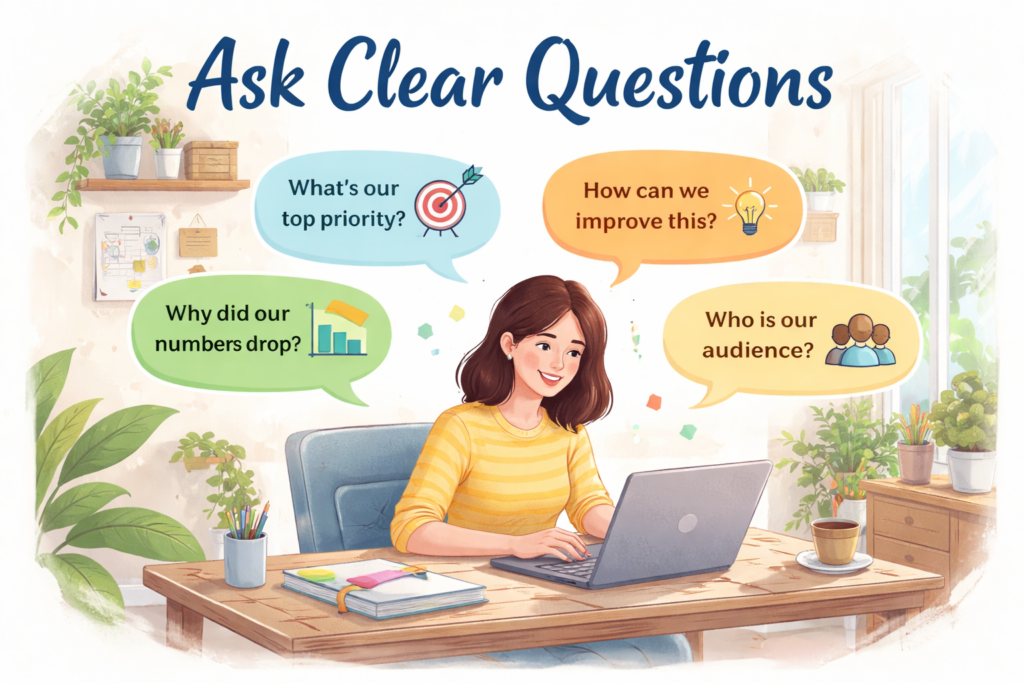
AI systems extract information more easily when headings are written like questions.
Instead of headings like:
- “Content Strategy Tips”
Use headings like:
- “How to Optimize Content for AI Overviews”
- “What Is an AI Overview?”
- “Why Do AI Overviews Matter?”
Question-based headings improve clarity and increase extractability.
2. Give the Answer Immediately

AI prefers direct answers placed right under the heading.
Example:
What is an AI overview?
An AI overview is an AI-generated summary shown at the top of search results, created by combining key information from trusted sources to provide quick answers.
Placing short definitions early increases your chances of being referenced.
Avoid long introductions before answering.
3. Keep a Strong Content Hierarchy

AI systems analyze formatting to judge how clearly information is organized.
Use:
- H2 for major sections
- H3 for sub-sections
- Bullet points for lists
- Numbered steps for processes
A clean structure makes content easier for AI to interpret.
Messy formatting reduces your extraction potential.
4. Optimize With Semantic SEO and Entities

AI search depends heavily on meaning, context, and entity relationships.
Instead of repeating the same keyword, include related terms naturally throughout your content.
For AI overview optimization, include entities like:
- Generative search
- Answer Engine Optimization (AEO)
- Structured data
- E-E-A-T
- Conversational search
- Featured snippets
Entity-rich writing strengthens topical relevance and improves AI understanding.
5. Improve E-E-A-T Signals

Experience, Expertise, Authoritativeness, and Trustworthiness strongly influence AI selection.
To strengthen trust signals:
- Add expert insights
- Support claims with data or research
- Include real examples
- Show practical industry knowledge
- Stay consistent in your niche
AI systems prefer credible content over surface-level writing.
More trust = higher chance of overview inclusion.
6. Add Structured Data (Schema Markup)

Schema helps search engines interpret your content more clearly.
Use structured data for:
- FAQs
- Articles
- How-to content
- Organization details
- Reviews
Schema improves content clarity and can support AI extraction.
Structured pages generally perform better in AI-driven SERPs.
7. Write for Conversational Search Queries

AI overviews are often triggered by natural-language searches.
Optimize for queries like:
- “How does…”
- “What is…”
- “Why is…”
- “Best way to…”
Write in a natural, conversational tone — but keep it professional and authoritative.
Conversational alignment improves your chances of being selected.
8. Increase Information Density

AI systems prioritize content that delivers strong value quickly.
Avoid:
- Fluff
- Repetitive filler
- Overly promotional lines
Instead, focus on direct, meaningful explanations.
Information density matters more than word count.
9. Build Topical Authority Across Your Website

AI evaluates overall website expertise, not just one page.
One article alone is rarely enough.
Build clusters around your main topic.
Example:
Pillar Topic: AI SEO Strategy
Supporting Topics:
- SEO vs AEO differences
- How AI affects Google rankings
- Generative Engine Optimization explained
- Conversational search optimization
The more complete your topical coverage, the stronger your authority.
And stronger authority increases AI citations.
10. Strengthen Technical SEO Foundations

Even AI-driven search still relies on technical quality.
Make sure your website has:
- Fast loading speed
- Mobile responsiveness
- Clean URL structure
- HTTPS security
- Strong internal linking
Technical SEO improves crawling, indexing, and AI extraction.
Common Mistakes to Avoid

Writing Long, Unstructured Paragraphs
AI struggles with large blocks of text. Break content into clean sections.
Ignoring Internal Linking
Disconnected pages weaken topical authority.
Keyword Stuffing
AI understands context. Overusing keywords reduces readability and clarity.
Publishing Thin AI-Written Content
Surface-level content rarely gets cited.
Neglecting User Experience
Engagement and usability still influence trust.
AI Overview Optimization vs Traditional SEO
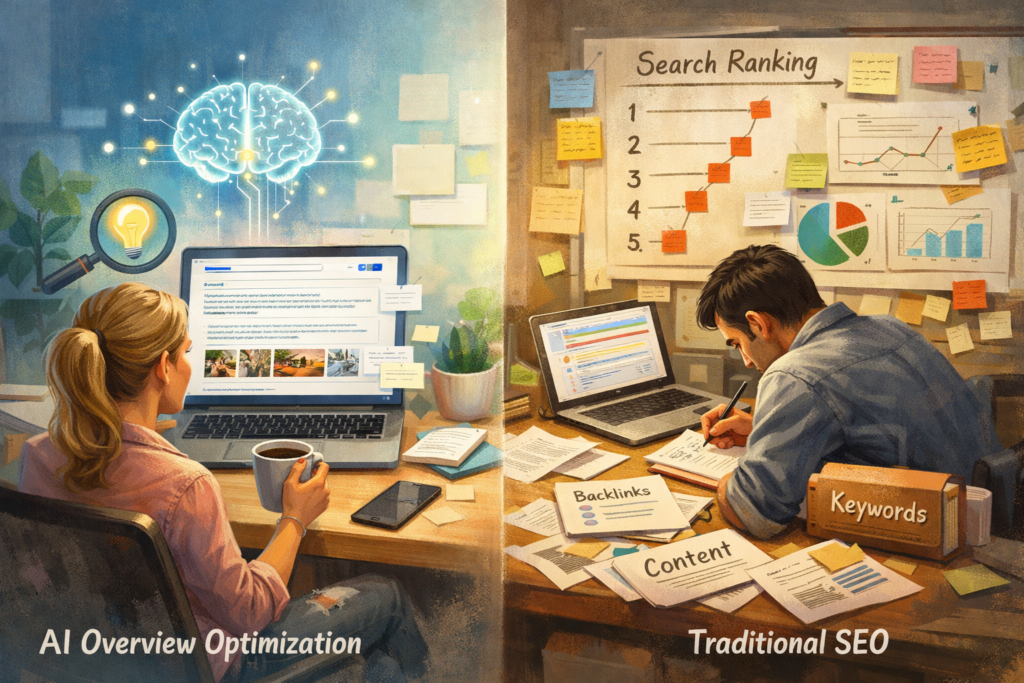
| Traditional SEO | AI Overview Optimization |
| Focus on rankings | Focus on being referenced |
| Keyword-driven | Entity + intent-driven |
| Click-focused | Citation-focused |
| Page-level approach | Domain-level authority |
AI overview optimization builds on SEO — it doesn’t replace it.
Measuring AI Overview Success
Tracking AI overview inclusion is still evolving, but you can monitor:
- Featured snippet presence
- Growth in branded searches
- Impressions in Search Console
- Time on page
- Engagement metrics
- Changes in SERP appearance
Modern SEO success now includes answer visibility, not just rankings.
The Future of AI Overviews

AI overviews will likely expand across:
- Informational searches
- Commercial research queries
- How-to searches
- Comparison content
Brands that optimize early will gain a visibility advantage.
AI search will keep evolving — and content strategies must evolve with it.
Frequently Asked Questions
How do I know if my content appears in AI overviews?
Track featured snippets and manually check SERPs for your target queries.
Does ranking #1 guarantee inclusion in AI overviews?
No. AI chooses content based on structure, clarity, and trust — not only rankings.
Can small businesses appear in AI overviews?
Yes. Strong niche authority and well-structured content can outperform bigger brands.
Is AI overview optimization different from AEO?
AI overview optimization is part of AEO, which covers broader answer engine strategies.
Final Thoughts
Learning how to optimize content for AI overviews is critical in 2026.
Search is moving toward answer-first experiences.
To stay competitive:
- Structure content clearly
- Provide direct answers
- Strengthen authority signals
- Use semantic SEO
- Build topical depth
Ranking alone is no longer enough.
In AI-driven search, clarity + credibility determine visibility.
Businesses that adapt now will build long-term dominance in AI-powered search.